Jump to Question
Pass I Assembler & Comparisons
Q.1 (a) Draw and explain flowchart of pass I of two pass assembler with example.
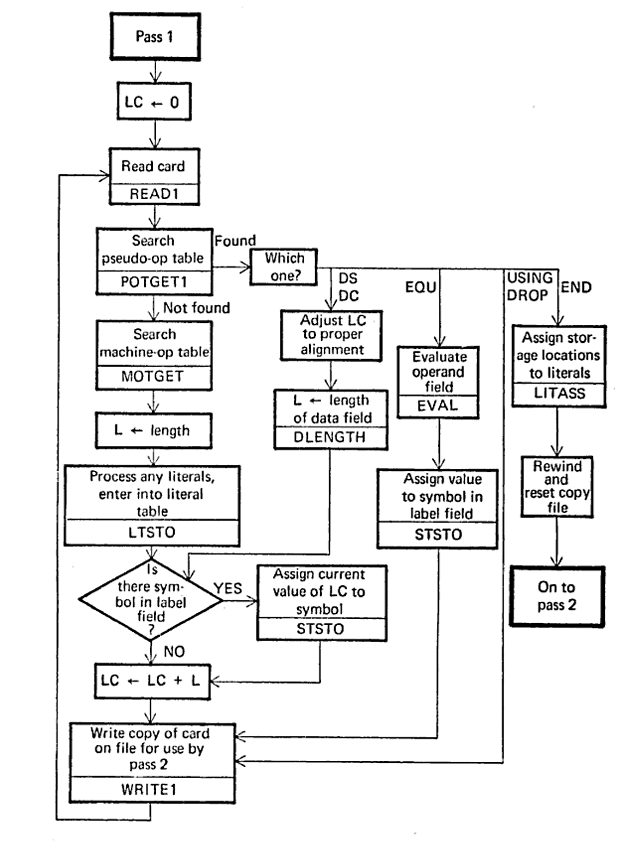
Figure: Pass 1 Assembler Flowchart
Explanation:
Pass 1 scans the source program to determine addresses of instructions/data. It builds Symbol Table, Literal Table, and Pool Table, producing intermediate code.
- Initialize: Set Location Counter (LC) from START.
- Scan: Read line by line. Update LC.
- Symbols: Add labels to Symbol Table with current LC.
- Literals: Add to Literal Table (assign address at LTORG/END).
- Output: Intermediate Code for Pass 2.
Q.1 (b) Differences
i. Literal vs Immediate Operand
| Feature | Immediate Operand | Literal |
|---|---|---|
| Storage | Part of instruction. No separate memory. | Stored in Literal Pool (memory). |
| Speed | Faster (no memory access). | Slower (requires memory access). |
| Example | MOVEM AREG, 5 |
MOVER AREG, ='5' |
ii. Assembler vs Compiler
| Feature | Assembler | Compiler |
|---|---|---|
| Input | Assembly Language (Mnemonics). | High-Level Language (C, Java). |
| Output | Machine Code (Object Code). | Machine Code or Intermediate Code. |
| Complexity | Simple (1-to-1 mapping mostly). | Complex (Optimization, Analysis). |
Pass I Simulation & Data Structures
Q.2 (a) Show output of Pass-I for the given code.
USING PROG+2, 15
L 1, FIVE
A 1, =F'2'
LTORG
ST 1, RES
FIVE DC F'4'
RES DS 4F
END
1. Location Counter Processing
| Line | Statement | LC |
|---|---|---|
| 1 | PROG START 50 | - |
| 3 | L 1, FIVE | 50 |
| 4 | A 1, =F'2' | 54 |
| 5 | LTORG (=F'2') | 58 |
| 6 | ST 1, RES | 62 |
| 7 | FIVE DC F'4' | 66 |
| 8 | RES DS 4F | 70 |
*Assuming IBM 360 style: 1 word = 4 bytes increment.
2. Symbol Table
| Symbol | Address |
|---|---|
| PROG | 50 |
| FIVE | 66 |
| RES | 70 |
3. Literal Table
| Literal | Address |
|---|---|
| =F'2' | 58 |
Q.2 (b) Necessity of Data Structures in Pass-I
- Symbol Table (SYMTAB): Stores addresses of labels for backward/forward referencing.
- Literal Table (LITTAB): Stores literals to assign addresses at the end.
- Pool Table (POOLTAB): Tracks literal pools to know when to assign addresses.
- Location Counter (LC): Tracks current memory address.
- Machine Opcode Table (MOT): Look up instruction lengths to increment LC.
Macros & Compilers
Q.3 (a) Phases of Compiler

Analysis (Lexical, Syntax, Semantic) -> Synthesis (Intermediate Code, Optimization, Code Generation).
Q.3 (b) Macros: Definition, Advantages, Difference from Functions
Definition
A macro is a named block of code that is expanded inline during assembly/preprocessing.
Advantages
- Code Reusability: Write once, use many times.
- Performance: No function call overhead (stack PUSH/POP).
- Readability: Meaningful names for complex code sequences.
Macro vs Function
| Aspect | Macro | Function |
|---|---|---|
| Expansion | Inline (Pre-processing). | Call/Return (Runtime). |
| Size | Increases code size. | Saves memory (single copy). |
| Speed | Faster execution. | Slower (call overhead). |
Advanced Macros
Q.4 (a) AIF and AGO Pseudo-ops
Used for conditional assembly within macros.
- AIF (Assembler IF): Conditional branch.
AIF (condition) .LABEL - AGO (Assembler GO): Unconditional branch.
AGO .LABEL
Example:
MACRO
CHECK &X
    AIF (&X EQ 0) .ZERO
    ADD AREG, &X
    AGO .END
.ZERO
    MOVER AREG, ='0'
.END
MEND
Expands macros in a single pass of the source code. Requires macros to be defined before they are called.
Working:
- Read source line.
- If it's a Macro Definition, store in tables (MNT/MDT).
- If it's a Macro Call, lookup tables and expand immediately.
- If standard instruction, output as is.
🎓 Strategic Points for SPPU Insem Exams
-
Focus Areas: Assembler pass structure and Macro data structures (MNT, MDT, ALA) are high-weightage topics.
-
Diagrams: Always draw the flowchart for Pass 1/Pass 2 Assembler if asked, even for 5-mark questions.
-
Numerical Problems: Practice tracing the LC and building SYMTAB for a given 5-10 line assembly code.
-
Comparison Questions: Be ready to compare Assembler vs Compiler, and Macro vs Subroutine.
5 High-Probability Exam Questions & Answers
Q1. Why is the START directive important in an assembler?
Ans: It provides the initial value for the Location Counter (LC), defining where the program will be loaded in memory.
Q2. What is the difference between a Positional Parameter and a Keyword Parameter in Macros?
Ans: Positional parameters must follow a specific order in the call, whereas keyword parameters are identified by names (e.g., ®=AREG) and can be in any order.
Q3. Give an example of a Pseudo-op used in Assemblers.
Ans: EQU (Equate) is a pseudo-op used to define a constant or a symbolic name for a value without allocating memory.
Q4. What is the role of the MDT (Macro Definition Table)?
Ans: It stores the skeletal body of the macro definition with positional notations used for parameter replacement during expansion.
Q5. Define 'Forward Reference' and how it is resolved?
Ans: A forward reference occurs when a symbol is used before it is defined. It is resolved by a two-pass assembler where Pass 1 collects all definitions and Pass 2 performs the substitution.
Summary for Quick Revision
This 2024 paper highlights the core fundamentals of System Programming. Key takeaways include the two-pass logic of translators, the crucial role of data structures like tables in managing metadata, and the efficiency gained through macro expansion. Mastering these patterns is essential for any engineering student studying SPOS.